
Atlanta: The Legacy We Have Inherited
Atlanta is a tale of two cities. Despite its history as the cradle of the civil rights movement, Atlanta remains one of the most segregated cities in the country. The northern and eastern neighborhoods are almost entirely White and the western and southern neighborhoods are almost entirely Black. These racial divisions align with the history of redlining and exclusionary zoning practices that predominated in Atlanta during the first half of the twentieth century. In 1922 Atlanta adopted a zoning ordinance dividing the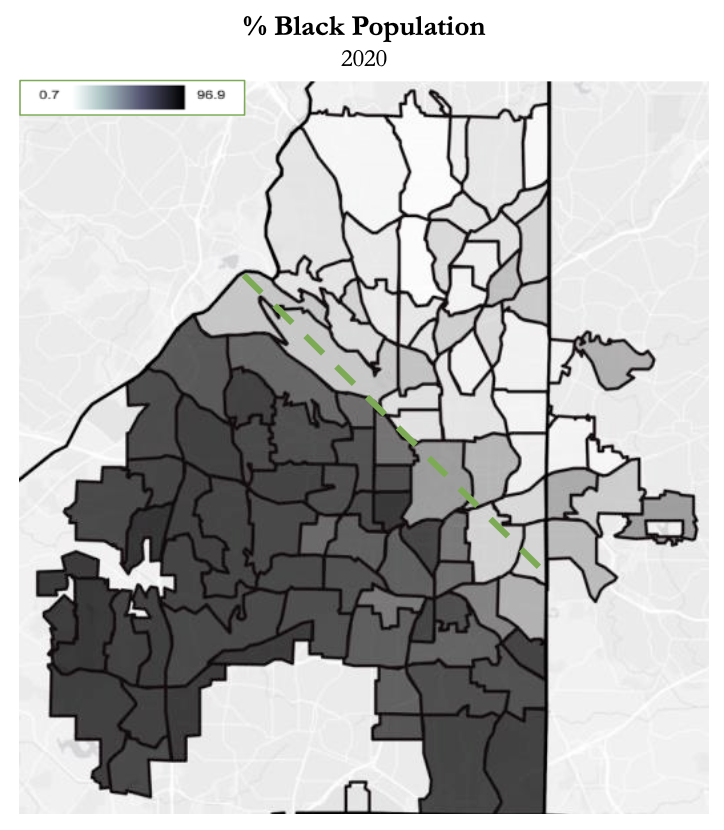 city into an “R-1 white district” and an “R-2 colored district.” The City’s Planning Director at the time argued that “home neighborhoods had to be protected from any further damage to values resulting from inappropriate uses, including the encroachment of the colored race.”1
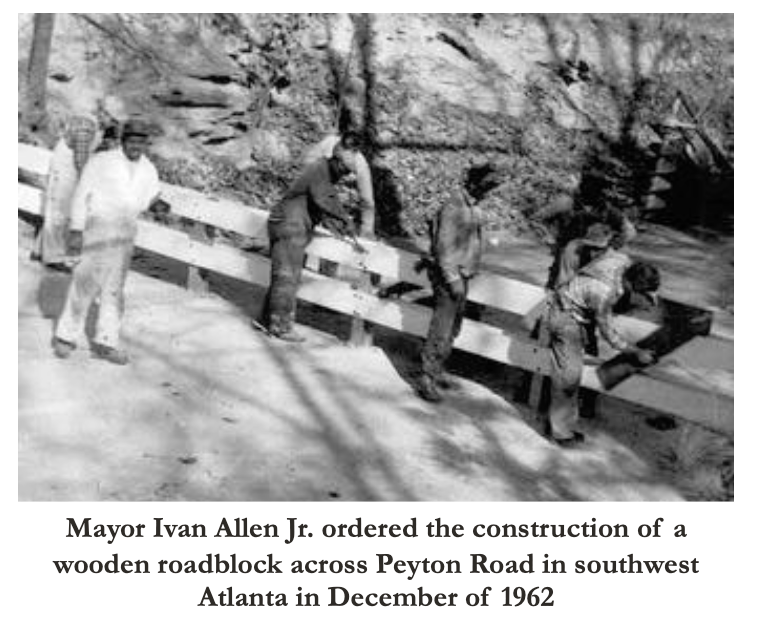
Although the Georgia Supreme Court ultimately struck down the statute, public and private practices ensured the spirit of the ordinance dictated settlement patterns across Atlanta. In the 1930s, the federal government created a map used to block investment and economically exclude communities of color, a practice called redlining. As late as 1962, the City erected a physical barricade on Peyton Road in southwest Atlanta to discourage Black families from moving to adjoining White neighborhoods. White residents insisted that a racial buffer was needed to prevent Black homebuyers from “intruding” on White blocks. The barrier stood for 72 days before it was taken down in response to a court order.
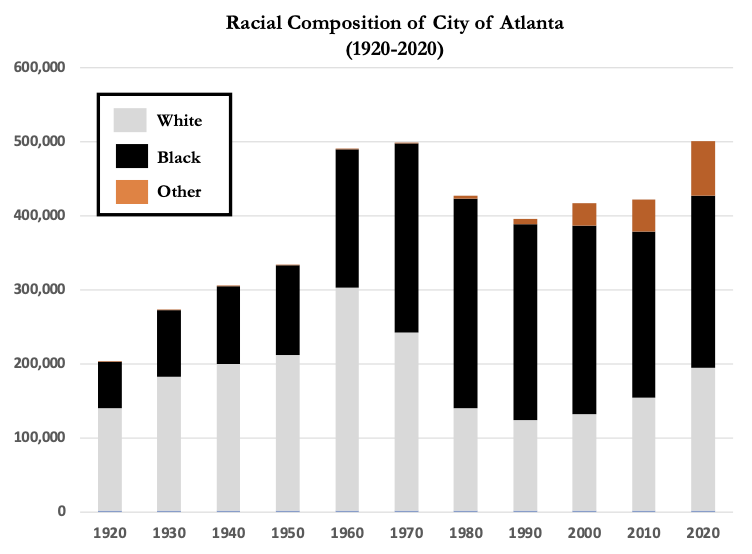
 Atlanta’s current racial contours took full shape during the 1960s, propelled primarily by the phenomenon of “White flight” as Federal housing policies incentivized the relocation of White families to the suburbs. The White population of the city shrank by over 60,000 over the decade and by 1970 Atlanta had become a majority Black city. Despite the increase in Black political influence that accompanied the transition to a majority Black city, patterns of racial segregation persist to this day. By some measures, Atlanta is the second most segregated city in the country, behind only Chicago.2
After more than two decades of population decline, Atlanta began to grow again the early 1990s. This re-urbanization wave - similar to that experienced in other cities across the country - brought with it new opportunities for wealth creation. In the north and east sides of the city, the predominately White neighborhoods experienced three decades of rapid growth and a commensurate increase in property values. On the other hand, most of the neighborhoods on the west and south sides of the city remained stagnant.
This geographic assymetry in investment over the past three decades is the primary reason why Atlanta leads the nation in wealth inequality. The median wealth of a White household in Atlanta is $238K, the median wealth of a Black household is $5K, which means that the median White family in Atlanta has 46 times the wealth of the median Black family. The national average is 12 times.3
1Rothstein, Richard (2018) The Color of Law. Liveright Publishing Corporation.
2Silver, Nate (2015) “The Most Diverse Cities are Often the Most Segregated.” 538.
3Urban Institute Financial Health and Wealth Dashboard
Achieving Fairness of Place
In 2022, newly-elected Mayor Andre Dickens committed his administration to creating a city of vibrant and thriving neighborhoods where all children can flourish:
I am prepared to adopt the goal of 100% healthy and thriving neighborhoods as the central strategic imperative of my administration, and to reorganize the effort of government around that goal...By joining together – right now, today – by strengthening our partnerships and aligning our missions; by working together in a spirit of innovation and service; by focusing on transforming our most disinvested places; and by centering equity and the voices of our residents, we can make Atlanta the best city in the country to raise a child. Business as usual is not going to work. We need to reimagine a future for our city. A city of healthy, thriving neighborhoods that are structurally accessible to people of all races and income levels. Neighborhoods that are safe, healthy, culturally rich, with good schools and dynamic economies. If we can achieve that goal, then all the outcomes we all care about – public safety, educational opportunities, health equity, economic mobility –will improve.4
Given the need for ongoing public sector support and leadership for this initiative, Mayor Dicken’s created within his office a new team of twenty professionals with expertise in neighborhood revitalization, housing, education, economic development and public-private-philanthropic partnerships. This first-of-its-kind organization is working with neighborhood leaders, place-based non-profits and other key stakeholders to develop and implement the neighborhood transformation plans required to deliver this vision.
There are 46 neighborhoods in Atlanta that have been in distress for several decades and show few if any signs of improved health. These neighborhoods have a collective population of 175,000, which is 36% of the city. The population has declined over the past decade in these neighborhoods and on average 30% of the residents live below the national poverty line. The City has selected six of these neighborhoods as initial targets of revitalization. The transformation plans for these six neighborhoods are now largely in place, are supported by the local agencies and nonprofits needed to execute them, and form the basis for the Achieving Fairness of Place Atlanta Action Plan 2044. You can learn more about this initiative and plans here.
4From Mayor Andre Dickens remarks to the Atlanta Foundations Forum, 2022